
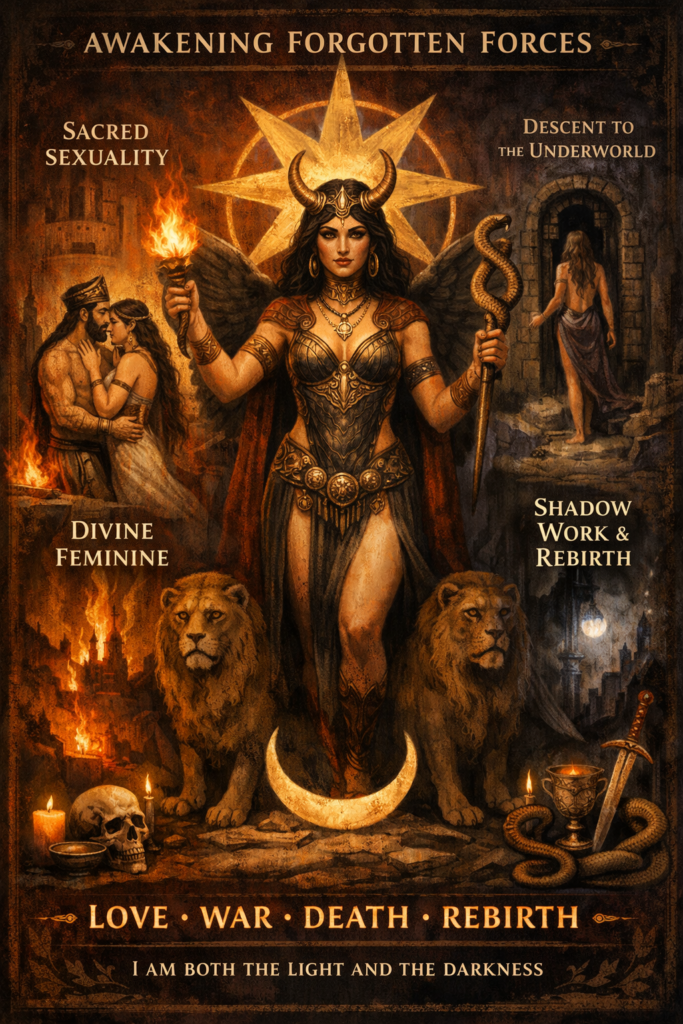
Awakening “Inanna, The Forgotten One”
Inanna’s worship was central to ancient Mesopotamia, but many of her practices, especially those linked to feminine power, sexuality, and mystical rites, have been suppressed in later patriarchal societies. Her return to modern esoteric and magical traditions is seen as a revival of these forces.
If we consider that Inanna’s worship in ancient Mesopotamia was integrated into the society’s ritual and cosmological structure, we realize divinity, sexuality, and mysticism put together, empowered both the individual and the collective. Its suppression in later patriarchal societies distorted, over time, the full understanding of Inanna, reducing her to a more conventional or allegorical figure, divorced from Her full primordiality. The revival of Inanna attempts to reconnect with these ancient powers once celebrated and revered.
Inanna was not a goddess as we have grown used to, a goddess of the passive aspects of femininity, but the active, creative force that governs the physical and psychic world. Her worship permeated every aspect of mundane life, especially in relation to sexuality. The sacred marriage ritual, in which the high priestess of Inanna would engage in ritualistic sexual acts with the king or a priest, is a vivid example of how sexuality was seen as a natural act that was mystical. Through these rituals, fertility was invoked for prosperity, abundance, and divine granting.
With the decline of the Great Goddess traditions, Inanna became increasingly demonized. In the Abrahamic religions, for example, sex was often to be restrained rather than celebrated. The functions of Inanna were systematically taken by male divine figures. The ancient mystical rites, especially those that involved sexuality and ritual power, were obscured or driven underground, and the dominant patriarchal narratives took precedence.
Despite millennia of suppression, this revival reclaims sexual expression in the figure of Inanna, being reinterpreted as a symbol of feminine strength and sexual autonomy. Through Tantric sex and sensuality, practitioners are rediscovering pleasure as a holy and creative gateway.
Also, modern mystical practices, especially those involving shadow work, draw on the narrative of Inanna’s Descent. Her stripping away of garments in the underworld is seen as the letting go of attachments to reach rebirth. Inanna’s role as a warrior goddess, when combined with fertility and love, is thought to integrate the feminine and masculine today. Increasingly, practitioners are attempting to assimilate both genders or polarities within themselves. Inanna’s presence in contemporary practices can therefore be seen as inspiring wholeness.
Feminine mysteries and sacred circles draw directly from Inanna’s archetype, as from other ancient goddesses. This revival is a way for people to free their personalities and reconnect to Nature.
But it is enough to take a look at this article as a whole to realize that Inanna’s return to modern spiritual and esoteric traditions does not yet represent a revival of the ancient primal forces that were once central to understanding life, death, and the in-between. Although these forces, long suppressed by patriarchal and institutionalized religions, now find a renewed space, they are still a seed without a structure, an impulse without a world. Inanna offers authority and divine sovereignty, life-giving forces of the Earth and the Cosmos. Her true return would be beyond comprehension to most New-Age practitioners, who often still sanitize or abstract her essence into more palatable, conventional forms. While Her worship and recognition represent Her divine energy, these efforts remain shallow in their engagement. What’s crucial to recognize is that Inanna is already alive in the world, unacknowledged. Inanna is as empowered by femininity, sensuality, and sexual liberation as by destruction, chaos, and war. Inanna’s work is not about pleasure or empowerment in itself, but integration and surrender. Inanna’s descent to the Underworld is not self-help; it is the loss of identity. Her authentic presence is not something we must search for; it is ever-found. Her face is not the beauty or sensuality often glorified in modern culture, but the rawness behind the cyclical patterns of life, death, and rebirth that educate us. She is in each woman who grapples with the loss of self in the face of societal expectations, and in all that remains suppressed by patriarchy and institutionalized systems of control.
Inanna embraces all aspects of being, creation to destruction, nurturance to wrath, and has always existed in the world. It will not be the idealization of the feminine often seen in figures like the Virgin Mary. It will not be disconnected from the primal. Inanna is in the powerful breath that gives life to every woman and every man, and to the Earth. Unpredictable and untamed, this power requires that death be accepted as part of the human experience.
Inanna’s face lies in the darkness of the moon, in the fury of a woman standing up for her truth, in the fire of a revolution, in the storms of life that dismantle the false identities we cling to.
The role of the Adept in the face of Inanna is not to worship her nor to reduce her to symbols of empowerment, sexuality, or personal change. Instead, the Adept’s path is an expression of what She truly is, seen through to the primal forces. The Adept must recognize what Inanna endured externally and enact it internally. And the Adept must not seek redemption from this process.
This world functions on Inanna’s elixirs; the Adept’s task is to develop the sight that perceives it. To stand beyond the domesticated forms at work in the world is not about reviving an ancient goddess for modern spirituality. The Adept’s role is to remain awake, to become a paradox that cannot be confined.
This means rejecting the belief that light must oppose darkness, that power is separate from surrender, or that the spiritual and the material must be divided. To truly walk with Inanna is to stand beyond contradiction, to be both sovereign and sacrificed, lover and warrior, creator and destroyer in constant self-overcoming. Inanna’s power is the sovereignty of one who has died.
Cultivate and wield this death wisely. Move between realms at will; see through falsehood and guide others past it; embody all opposites and move power in harmony with the laws (e. g. you do not fight the underworld, you surrender to it because the laws of descent require loss; you don’t conquer fate, you move within it; you don’t force transformation, you create its conditions). The Adept, in the end, is not a disciple of Inanna, nor a follower, but She, terrible and sacred, the World finally remembered..


