
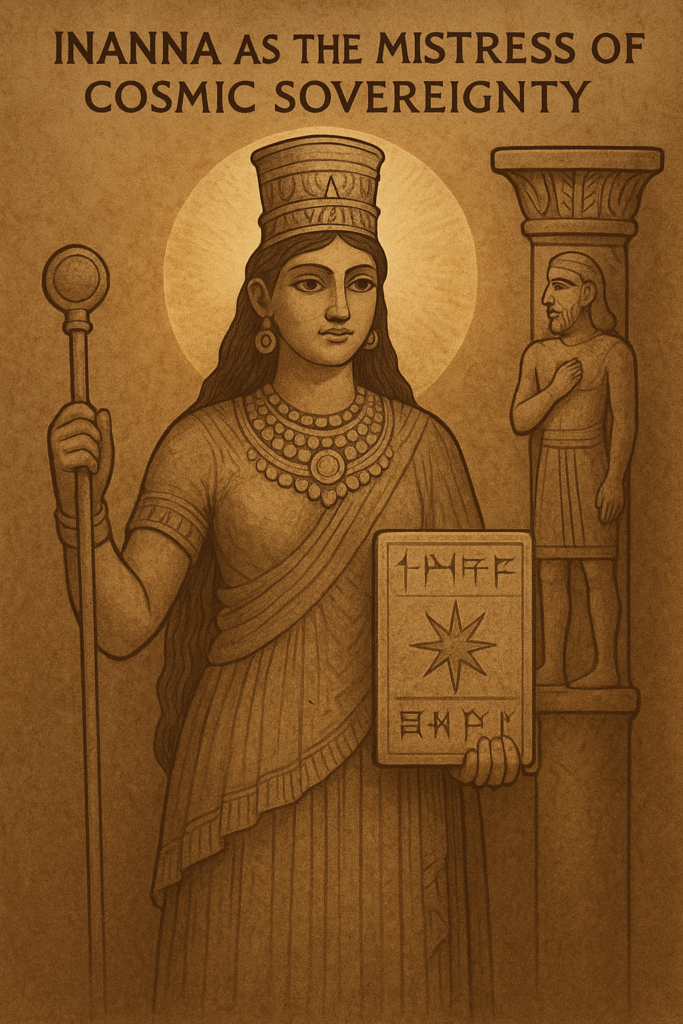
Inanna as the Mistress of Sovereignty
In Mesopotamia, kings had to be blessed by Inanna to legitimize their rule, and the Sacred Marriage ritual (hieros gamos) between Inanna and Dumuzi marked this blessing.
The name Dumuzi (𒌉𒍣, Dumu.Zi) has 𒌉 Dumu, meaning “son” or “child” and 𒍣 Zi, meaning “faithful,” “rightful,” or “true”. Thus, Dumuzi can be translated as “the faithful son”, “the true son”, or, by context, “the legitimate child”. This points to him as a shepherd-king, the rightful ruler, and, necessarily, Inanna’s consort, who was chosen by her to maintain fertility and leadership.
Dumuzi, like later figures such as Osiris, Adonis, and Dionysus, dies and is resurrected in cycles, reflecting, below, agricultural fertility and, above, the transformations of the soul, as well as the consciousness that remains throughout all changes. As such, he is the ruler of cosmic and earthly rhythm. In marrying him, Inanna’s passion marries abundance and the necessity of sacrifice to sustain life and civilization. As the earthly counterpart of Inanna, Dumuzi sustains self-preservation, as Her divine consort, he is a civilization in the image of cosmic balance, ruled by the triangle of life, death, and resurrection on his end and love, sacrifice and power on Her end, made possible by the union of masculine and feminine polarities bringing forth the fertility of the Earth and of human existence. Inanna’s love and war is the active, fiery principle, while Dumuzi, as her consort, brings forth the passive, receptive force that grounds and nurtures.
When Inanna descends to the Underworld, the realm of her sister Ereshkigal, Inanna is the originator of the principles of death, transformation, and rebirth. After Inanna becomes trapped and returns, Dumuzi, as She so often has done with other deities, takes into himself these principles by occupying Inanna’s place in Kur (Irkalia), beginning a cycle of sacrifice and renewal. Dumuzi’s time in the Underworld is temporary, and is expressed by the very sacrificial aspect of kingship in which the king must die and be reborn to reaffirm the vitality and prosperity of the land (“the king is dead, long live the king”). Dumuzi’s then represents the cycle that occurs in the natural world as well through seasonal rhythms.
By such means, Dumuzi tames Inanna’s passion in the name of nourishing the community: Inanna would not have the power to grant kingship were each mortal king not Dumuzi, the divine mediator between the gods and the people. While this may be seen as Inanna’s vulnerability, the king’s vulnerability is that, although he suffers divine anointing, it also places him in the position of sacrifice intrinsic to transient power, dependent on the favor of the gods and the continual cosmic cycles. The king is divine only because Inanna has awakened and cultivated his desire as a divine force that drives transformation and manifestation. His life and his death, his willing sacrifice and his rebirth, his yearning to unite with the divine and express that union in the world, exist between Inanna’s temple columns of Desire and Power.
It makes sense today to consider any Inanna adept in the role of the king, be it male or female, and let’s remember Inanna’s spreading of the fire was also responsible for the blurring between genders. Thus, it would make sense for the Adept to recall that Inanna’s role as the grantor of sovereignty in Mesopotamian kingship rituals is not just a political function; it is esoteric, tied to the alchemy of magical authority and the union of heaven and earth. Inanna possesses the Me, the divine decrees of civilization, the laws, arts, knowledge, and structures that define the human world. When she takes the Me from Enki she becomes the cosmic force that establishes them. The king, in order to rule, must be infused with this power and cannot simply take the throne by force; he must be sanctified by the current of divine wisdom and order that Inanna carries. As She is the keeper of the cosmic current, only those who align with Her can wield power. Without it, Adepthood is hollow, disconnected from the greater order, and cannot be Adepthood.
In this mystical tradition, sovereignty can only be conquered by a mystical excess, ecstasy, and chaos where the goddess of wild sexuality and war grants kingship through movement, vitality, and intensity. If Inanna blesses the king, she devours and remakes him. To Inanna, a stagnant king is a dead king. A king without desire, hunger, and passion is just a bureaucrat. Inanna’s anointing is the infusion of fire, the ecstatic force of life. To sustain this, the shaman-king must be structured, stable, and wise to lead with vision and intoxication. Enlil (air, command) and Anu (sky, supreme deity) are gods of cosmic law, but they are too distant, too cold, too impersonal. Enlil can decree kingship, but he does not infuse it with life. Anu is the supreme god, but he does not descend into the world to touch it. Only Inanna descends. She walks among humans. She feels, suffers, and exults. In Her celestial body there is power and pleasure, war and love, creation and destruction, and a king cannot rule from a distant throne of abstract authority; he must be alive with the force of the world and the desire to shape it. Inanna’s fire, then, decrees a new breed of rulers that, beyond rulers, become forces of divine will. With Inanna, the king is civilization itself, radiant, dynamic, and charged with ecstasy.


[…] Click Here For Part IV […]
[…] Click Here For Part IV […]