
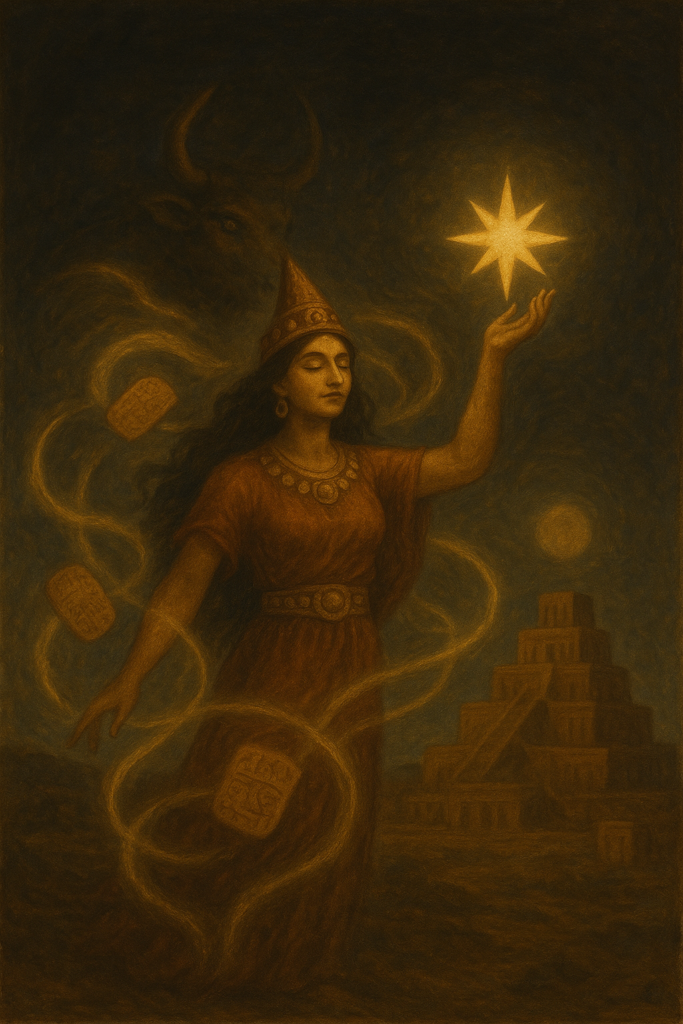
Inanna as the Mistress of Cosmic Sovereignty
So we have traveled from the “Mighty Place” or “Abode of the Deep” called Eridu, ruled by Enki, to the “Dwelling City” and “Sacred Settlement” called Uruk. As Enki gets intoxicated by Inanna and gives the Me to Her so She can take it to Uruk and give it to the people, so does a flood arise that submerges Eridu (whose temple stood over the waters of the deep), and Uruk becomes the capital of civilization. This all means the waters have risen.
In here, we have a shift from the primordial wisdom of Abzu and deep knowledge to human civilization and cultural dominance. Enki, god of wisdom and magic, loses influence to Inanna (Ishtar), goddess of love, war, and power. Esoteric, hidden knowledge held by the priesthood shifts to open rulership, divine kingship and cultural expansion. From an Era before the Flood, ruled by old divine order, we enter a new order after the Flood, the rise of urban civilization as we still know it. In the heart of all the wildness of our civilization masquerading as order, lies a bottomless orgy. But we have been disconnected from its power sources and have yet to tap into the waters that have arisen, to taste a depth that submerges the surface. We engage in it (the power sources) like automatons. We have lost touch with Inanna and move as specters in the House of Heaven, seeing not the stars but the corpses of tomorrow. This is yet Ereshkigal’s city.
Inanna and the Technologies of Ecstasy
Inanna was associated with sexuality and ecstatic rituals performed by Her priestesses and cult followers in Her temples, like the Eanna (House of Heaven) temple in Uruk. Her worship involved ritual music, dance, intoxicants, and trance states.
In my book A Guide to Stellar Magic & Astrological Mysticism (Falcon Books Publishing) I attribute to Inanna a cosmic letter from a work of Franz Bardon named The Key to the True Quabbalah.
The association we have given it is with the letter P, that expresses the divine and most inner aspects of love and sensuality:
“The quabbalist who calls upon this oscillation in the akasa principle will feel the desire to strive upwards to the Divine Light; he will sense an ever-increasing profound longing for his unification with the four basic divine qualities and will realize how divine love, which is incarnated into every human being, will constantly urge him to be connected to divine omnipotence, love and wisdom and to have these incarnated within himself. The longing for unification with the four basic divine qualities is a specific sensation which is only comprehensible to the practical expert and which one may live through but never be able to explain. (…) In the mental body, this oscillation evokes a deep religious sensation, a feeling of devotion towards highest infinity (…) , it evokes the ability to perceive beauty from the universal standpoint as the outcome of perfect harmony. Only the honestly striving quabbalist is able to experience the true essence of beauty without being bound by outside appearance, which usually is a relative thing. The sensation of absolute beauty and harmony in their absolute purity and profundity can only be achieved by the mastery of this letter oscillation. (…) As soon as the quabbalist also masters this oscillation materially, he will be able to achieve, in the material world, everything relating to the reproductive instinct, to maternal love and love for children and to many other things.”
Yes, Inanna still represents the orgiastic and chaotic energy of urban civilization, especially in contrast to the older, more traditional authority of Enki in Eridu. She is ecstasy unrestrained and the transformations that define city life, including sexual liberation (sacred prostitution, fertility, desire, transgression), commerce and trade (a bustling, ever-changing economic system), warfare and power struggles (the constant competition for dominance) and cultural expansion and creativity (arts, music, and innovation). She governs civilization by igniting it, unleashes it as she unleashes the Bull of Heaven, and destabilizes patterns. The orgy-like, excessive energy of Inanna breaks barriers and drives progress through chaos.
This act is the violent birth of a cosmic orgy of power in which She pulls divine forces from their controlled, hidden state (Enki’s wisdom in the Abzu) into the open and ecstatic urban world of Uruk. Then, cities consume and transform raw resources, mystical traditions, and human desires into something excessive, unpredictable, and constantly evolving, in which Inanna empowers kings and brings them down, governs sexuality and love in the same bed as war and death, and her bed is a city that, like Inanna, is a palace of pleasure, wealth, excess, and art, violence, instability, and conquest.
Her orgiastic nature is not just about sexuality, it is about the total force of civilization where everything mixes together in an uncontrollable, intoxicating flow. But throughout it all, the Queen of Heaven shines as a star in the core of the heart and imbues everything with meaning unless, like a sailor whose sky is clouded by constant tempests, we avoid Uruk, divert our senses, and lose sight of the stars.
No, to remain aware is to know Inanna’s excess, chaos, and eroticism is an elevated longing. Inanna’s carnal love is sacred love, her wild passion and ascencion. She shatters the walls between pleasure and pain, her chaos is order, her death is life, her humanity is divine.
The drive toward omnipotence, love, and wisdom is the fire of longing that fuels Inanna’s power, her descent into the Underworld, and her sexual and cosmic conquests. And we, too, are driven by an overwhelming desire that destroys the self and must be quenched in the sexual abandon of mystical union as in the death and rebirth of civilization.
Inanna remains the Goddess of absolute beauty and harmony, but true beauty in the divine sense is not aesthetic; it is the balance of all opposing forces in its rawest form, beyond appearances. By extinguishing apparent limits, it creates new structures, civilizations, and paths. So is Inanna both the seductress and the devoted bride of the christic Dumuzi, the goddess of carnal pleasure and union beyond flesh. To call upon Her is to long, it is to call for the Divine Light while Inanna’s sex burns in holy fire.
Desire as Magical Will
Now, desire is one of the most fundamental forces in magic, it feeds intention and alters reality. Desire is the spark of manifestation. Inanna herself is its body, Her passion drives Her to take the Me from Eridu, descend into the Underworld, and claim her cosmic sovereignty.
In Kabbalah, desire (רצון Ratzon) is the engine of creation as the divine will forms the cosmos. In Thelema the True Will is one’s highest, most refined desire. In Tantra, desire is ultimately enlightenment. Without longing, magic is lifeless. But there are two types of desire in magic, and to understand them may define the difference between Ishtar’s lions and their victims. Base desire is undirected desire ruled by impulse and devoid of intention. It dissipates energy instead of focusing it. Refined desire is called magical will. This is harnessed desire, where longing is directed. Inanna’s erotic, sovereign, and warlike desires drive her toward divinity and, when mastered, become an unstoppable force in magic.
The goal is not to consume aimlessly but to be illuminated. It should be Divine Ecstasy that manifests sex, Union that manifests devotion, not the other way around. Soon, you will find there is no craving in the House of Heaven. When we are focused and mount the Bull of Heaven, everything is manifestation, flesh, and engagement. Inanna, too, begins as a goddess of sensuality and power, but the Underworld strips her of everything and dresses her in a wisdom deeper than that of Enki. This is why ritual, symbols, and myth exist: to give shape to the magician’s longing, a longing so deep that it rivals Abzu, and reality bends around it. The hunger, the need, the ache of wanting pleasure is never as deep as the desire for transcendence, and sex becomes a symbol of transcendence. The thirst for power and control is never as intense as the yearning for sovereignty over the self, and power and control become a ritual for the latter. To marry Inanna is a continuous peeling away to reach and reach again the essence of what the soul longs for.


[…] Click Here for Part III […]
[…] Click Here For Part III […]
[…] Click Here For Part IV […]