
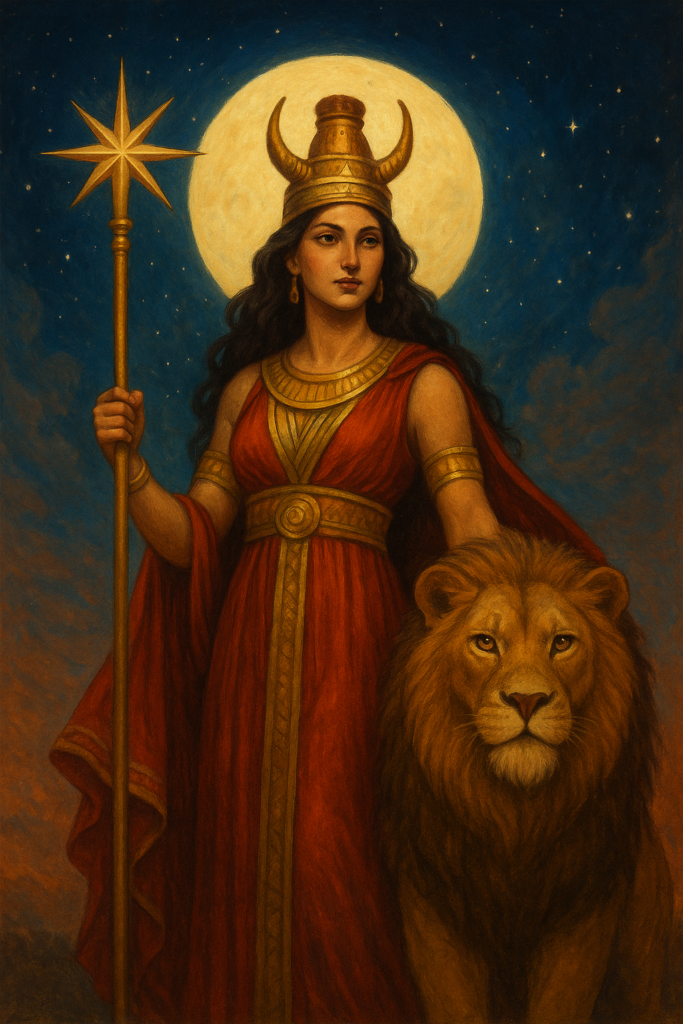
Inanna is the keeper of divine mysteries, the guide through ecstatic states, sovereignty, and the descent into the occult. To work with her is to awaken forces that have been forgotten in our society, as we will be able to see, but that kept active in it all throughout.
This idea of Inanna is not a modern idea but comes from the cradle of civilization, from Mesopotamian texts of Sumer, Akkad, and later Babylonian traditions (as Ishtar). It turns out that if we deeply lean over this topic, we can dispense with many other later manifestations of this same principle we call Inanna or Ishtar.
But first, to understand this notion of principle, we must not differentiate between personal character and cosmic law, as we have become accustomed to doing. In the human world, a person is relative to his or her conditions and undergoes changes in accordance with them, while a universal law is fixed, remaining a continuous part of nature as a whole. Yet in the world of the gods, as it should be in the human world, universal and personal are the same. The gods are universal principles, and these universal principles are alive and intelligent. The universal or eternal principle moves freely and of its own accord in the relative world.
To know the principle, like with any other principle, we search after its axiom and its formula, and so, we formulate “Inanna = Ishtar”.
For Inanna, we will be adding 𒆜 (kaskal), meaning journeying, to go, and to conquer, as an epithet, and have it implicitly applied to Kur, for Kur expresses where Inanna goes heroically. “Inanna” (𒆜𒀭𒈹), then, can be broken down into “Inan” and “na”. “Inan” refers to “the lady” or “the queen,” signifying her high status and sovereignty. I choose to see “Na” as a suffix meaning “mistress”, defining her as a goddess of power and rulership.
Another meaning that is encoded in the same name has “in” meaning “lady” and “anna” referring to the divine. Thus, the name ultimately translates as “Lady of the Divine” or, as commonly taken, “Lady of the Heavens”.
The name Ishtar is the Akkadian and Babylonian variant of Inanna and has a slightly different etymological background, though it is still closely related. “Ishtar” (𒀭𒋛𒁯𒌓) or Ištar is derived from the Akkadian and Semitic roots.
“Išt” is the first part of the name, meaning “star”. In many Semitic languages, a variant of this root refers to celestial bodies or the heavens, since the “Iš-” 𒋛 in Ištar could be a phonetic adaptation of ʾŠ- in the Semitic ʾŠTR root, related to fertility, brightness, or divine power, all linked to Venus. In this case then, star indicates the goddess’s association with the planet Venus, the “star of the morning” or “evening star.”
“Tar”, the second half of the name, can be a part of the Semitic structure of divine names, serving as a grammatical tool in constructing names linked to the heavens and planetary forces. The suffix “-tar” leads us to the astral quality of Ishtar. What we know for sure is 𒋻 tar (not included above because of integration into 𒋛) means “cut, decide”, and we attribute it to the deity’s role in making decisions or judgments regarding the fates of individuals, nations or events, much like how astrology is understood as the “art of deciding” or foreseeing outcomes based on the movement of celestial bodies.
As you may know, in Mesopotamian astrology, the movements of the planets, stars, and constellations were seen as divine decrees or judgments that influenced the fates. If we think about a goddess like Ištar/Ishtar, associated with Venus and key in Mesopotamian astrological charts, her celestial influence shapes events on Earth.
This interpretation not only makes sense within the context of astrology but also underscores the divine authority attributed to these gods, especially in matters influenced by planetary movements.
Ninurta is referred to sometimes in his full form as Ninurta-tar, Akkadian god of war, agriculture, hunting, and the protector of the king. He means strength and the defeat of enemies. The suffix in this context, as well, shows his powerful, divine, and astral qualities, which place him as a protector deity with celestial strength.
Yet Marduk, too, the chief god of Babylon, god of creation, justice, and magic, in his role as a celestial deity, can be seen in the sky as the planet Jupiter. Marduk carries no suffix, and we are left with the dichotomy of Venus and Mars. This is likely because Marduk, having created the world we inhabit, is meant to rule it rather than merely influence it.
Be that as it may, Ishtar breaks through and lends her “Tar” to a deity in the Canaanite and Phoenician pantheon, Astarte (also called Ashtart or Ashtaroth), closely related to Ishtar and sharing similar attributes, including being associated with love, fertility, and war. The name Astarte or Ashtar is a cognate of Ishtar, although part of a larger mythological family, and it remains to be seen where else might “-Tar” have travelled to.
In this formula, then, Innana is predominantly quality, the divinity of the heavens one can reach through mysticism and devotion, and Ishtar is predominantly quantity (astrological influence), reached through metaphysics and magic.
So now we are to examine the names letter by letter, since we are in the realm of a magical language, in which the words create philosophical and magical formulas.
The cuneiform sequence 𒆜𒀭𒈹 can be broken down into its individual components as follows:
𒆜 (applied to kur) has a triple meaning; it means “mountain” or “foreign land” (Sumerian and Akkadian) and, in certain contexts, “netherworld”, the world of the dead. It is easy to see how the three coincide, the mountain is the way to the stars, but it, itself, is the netherworld, a foreign world to Inanna that she came to know. From the standpoint of the magician, the astral realm is formulated.
𒀭 (dingir) is the divine determinative, which means that the word is the name of a deity. It is not pronounced in speech but marks the name as divine. From the standpoint of the magician, divinity is invoked in the astral realm.
𒈹 is commonly associated with Inanna, but can also refer to Nanna (the moon god), though this depends on the full context of the writing. We see, then, that it commonly indicates the light in the night, awareness in dissolution. From the magician’s standpoint, the deity previously invoked is evoked.
So, at once, in 𒆜𒀭𒈹 we have “The Mountain Goddess Inanna”, in her celestial domain and on her journey across regions as a star, and “Inanna of the Netherworld”, in Inanna’s famous Descent to the Underworld, where she passed through the seven gates to face Ereshkigal (we will get to this in due time).
Now the cuneiform sequence 𒀭𒋛𒁯𒌓 can be broken down into its individual components as follows:
𒀭 (DINGIR), the divine determinative, has already been dealt with. From the standpoint of the magician, divinity permeates consciousness.
𒋛 (IŠ) is the first part of Ištar (Ishtar), meaning to “sprout” or “to grow”. It causes the expansion of divinity, ecstasy.
𒁯 (TAR/ŠAR) represents “tar” or “šar” depending on the context. In Akkadian, “šar” means “monarch”, “ruler”, or “sovereign”. If read as “tar”, we have “to cut, to decide”, implying an aspect of judgment or power, as seen before. In this case, we know it means both Tar and Sar simultaneously, and see no incongruence. For the magician, from the state of godhood in ecstatic trance we reach inner mastery and dominion.
𒌓 (DÙ / GU₄ / UŠ / UL), in which DÙ means “to build, establish,” GU₄ means “bull,” and UŠ / UL is simply a determinative or an ending sound. In Akkadian divine names, it functions as an honorific or suffix. Since DÙ means “to build, establish,” it indicates Ishtar as one who “establishes” love, war, kingship, or fate; Her essence in divine rulership as a goddess of sovereignty; and Her power over reality, that is, Ishtar’s role in magic and destiny. On the other hand, the bull is a symbol of fertility and kingship, and the constellation of the precession throughout the time of Ishtar’s worship, that is, the dominant constellation that rises with the Sun at dawn on the spring equinox in Mesopotamia. We may connect it as well to the Bull of Heaven (celestial untamed force), released by Ishtar upon Gilgamesh. This is the letter of outer mastery and dominion.
Then, 𒀭𒋛𒁯𒌓 (DINGIR-IŠ-TAR-ŠAR/DU) is “Divine Ištar the Ruler”, “Ištar, the Divine Queen” or “Ištar the Sovereign.” This is the “Ištar Who Decides Fate” or “Ištar, the Judge of Fate” who has gone to death to absorb it instead of being absorbed by it. And so, is she also “Ištar, the One Who Establishes Sovereignty”, which will connect her with a political power, city-building, and rulership that we will also explore.
Concluding, we have 𒆜𒀭𒈹 = 𒀭𒋛𒁯𒌓, and now we solve the equation to obtain a match between the figures (symbols), because Inanna has three symbols 𒆜 (x) 𒀭 (y) 𒈹 (z) and Ishtar four 𒀭 (y) 𒋛 (a) 𒁯 (b) 𒌓 (c). To balance the number of symbols on both sides without adding anything new, we’ll need to find a way to equalize the sides. Since Inanna has 3 symbols and Ishtar has 4 symbols, we need to adjust for the difference. Our approach will be to build equivalence. We rewrite the equation like this: (x+y)+z=(y+a)+(b+c).
On the left side, (x + y) represents the combination of Inanna’s sovereignty and divinity in which x = 𒆜 is her dominion over the netherworld, her rule over the occult and y = 𒀭 signals Inanna’s divine essence. (x + y) thus proves Inanna’s power to transcend earthly limits and delve into the mysteries, might, and divinity. It is matched on the left side by (y+a), the combined power of Ishtar’s divinity and ecstasy. y = 𒀭once again marks the divine essence of Ishtar, as the goddess invoked in sacred rites and symbolic acts. a = 𒋛 represents expansion, growth, and ecstasy, Ishtar’s powers of creation and liberation. (y + a) is the union of her divinity with her ability to bring ecstatic and creative change to the world. 𒀭 remains 𒀭, but 𒆜 we make equivalent to 𒋛, that is, Ishtar’s ecstatic trance is the key to Inanna’s power over the netherworld.
Again, on the left side, the side of Inanna, we are left with + z, the final part of her identity, represented by 𒈹 (Nanna), which signifies the light in the night, illumination during dissolution, and awareness. This piece reflects her role as a deity who brings clarity and consciousness in the darkest times, guiding the soul toward rebirth. It is matched, on the right side, by (b + c), the remaining mystical aspect of Ishtar’s energy and law, in which 𒁯 (TAR/ŠAR) represents sovereignty and judgment, Her authority as a ruler of both the celestial and terrestrial domains, and 𒌓 (DÙ/GU₄/UŠ/UL) represents her ability to establish, build, and create, with connections to kingship, fate, and divine mastery. (b + c) expresses her sovereignty over reality and her government over the forces of creation and destruction, wielding the power to build order and dominate in both the physical and metaphysical.
Then, in sum, Inanna’s light in the darkness is Ishtar’s capacity to rule opposites and command thus fate. That is, Her transformation and divine essence are Her divine expansion and ecstatic power. Her awareness rules and masters creation.


[…] Click Here For Part I […]
[…] Back to Part I […]